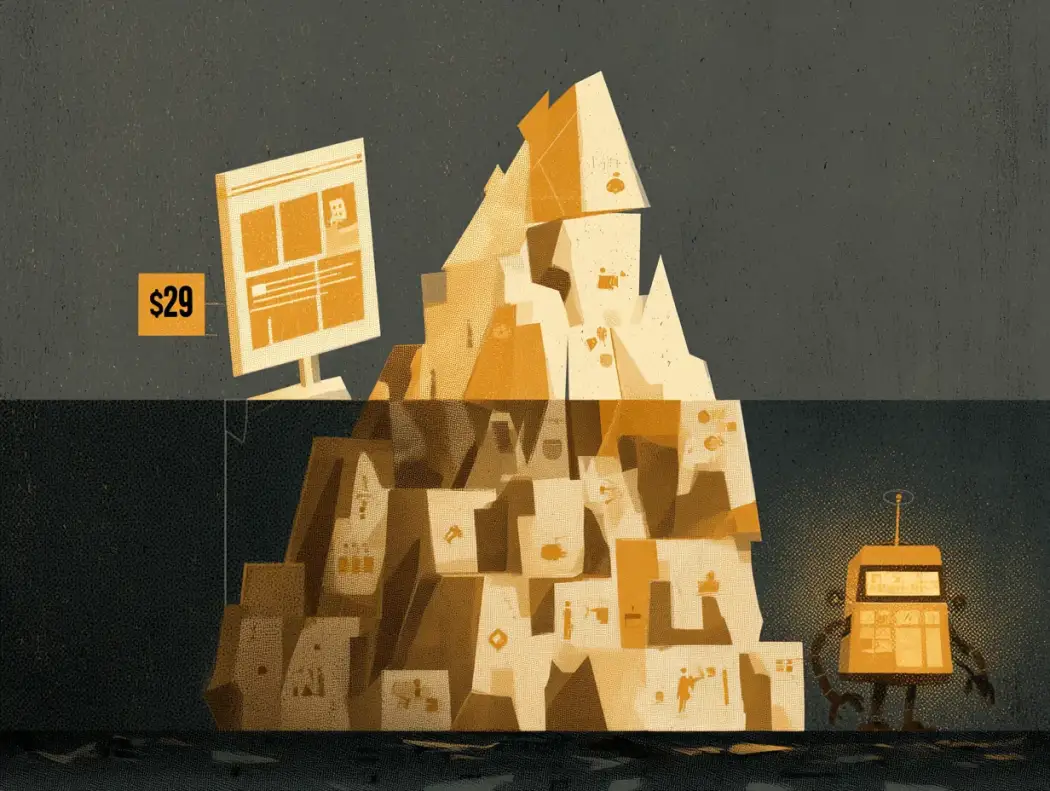
A DIY website for a service business costs between $3,115 and $8,465 in year one. The platform subscription -- typically $29/month -- is the smallest part. The real cost is owner time: 40 to 100 hours to build, plus four to eight hours a month to maintain. That time, valued conservatively at $50/hour, is what closes the gap between what the invoice says and what the site actually costs.
88% of people who search for a local business on their phone visit or call within 24 hours. The ones who don't usually found something on the way that made them reconsider. That something is often a website that didn't match the reputation of the business behind it.
The invoice from Squarespace or Wix reads $29 a month. The actual cost of a DIY website in year one runs between $3,115 and $8,465 for the average service business owner, and that number does not include the clients who checked the site and decided not to call. No invoice captures that.
There is a gap between what business owners believe their website costs and what it actually costs. Closing that gap is the only way to make a clean decision about what to do next.
What Does a DIY Website Actually Cost in Year One?
The platform subscription is the smallest line item. It is also the one that shows up in the bank statement, which is why it gets treated as the cost.
| Cost item | Year 1 range |
|---|---|
| Platform subscription (Squarespace / Wix) | $348 -- $588 |
| Domain registration | $12 -- $20 |
| Premium template | $50 -- $300 |
| Stock photo licenses | $200 -- $500 |
| Plugins and add-ons | $300 -- $600 |
| Owner time to build (40--100 hrs at $50/hr) | $2,000 -- $5,000 |
| Ongoing maintenance (4--8 hrs/month) | $2,400 -- $4,800 |
| Year 1 total | $3,115 -- $8,465 |
Time is the number that changes the math. Building a DIY site from scratch takes 40 to 100 hours for a first-time builder. That is not an estimate designed to make the project sound bigger. It is what happens when a business owner who is not a copywriter, photographer, or web designer tries to do three jobs at once. At $50 an hour, a conservative number for anyone running a business clearing $500,000 a year, the time cost alone runs $2,000 to $5,000.
Add maintenance. A site that goes without updates loses search ranking. A plugin left outdated creates security exposure. Keeping a DIY site functional and current takes four to eight hours a month for most service businesses. Over twelve months, that is another $2,400 to $4,800 in time cost, distributed in two-hour increments across a calendar that already has no room.
Most owners are surprised, because the $29 is the only number that ever came with an invoice.
Want to see the real number for your business? Use our DIY cost calculator to add up what your site has actually cost you.
Is Your DIY Site Already Costing You Clients?
There are moments that tell you the site has stopped working for the business before the analytics do. Most owners recognize them immediately when they hear them named.
You hesitate before sharing your own URL. A potential client asks for your website and instead of typing it in a text, you find yourself explaining what you do first, or offering to send a PDF instead. The site exists. You just do not want them to see it before you have had a chance to make a first impression another way.
A prospect goes cold after asking for the link. The conversation was going well. They asked for your website. You sent it. Then nothing. Not a rude response, not an objection. Just silence. You have no way to know whether the site was the reason. That uncertainty is part of the cost.
The site no longer matches what you charge. You raised your rates, added staff, moved to a better location, won better clients. The website still looks like the version of the business you were running three years ago. When a prospect lands on it before they meet you in person, the site sets an expectation you are working against before the first conversation starts.
Your Google reviews are strong and your search presence is not. Search presence means whether a stranger finds you when they're looking for what you do. A weak site means they don't. They call someone else. A 4.9-star average built over years of genuine client work is one of the most valuable assets a service business has. A website that cannot turn that reputation into search visibility leaves most of that value sitting untouched.
A competitor who is not better than you looks more established. Not because they are. Because they invested in looking the part, and the stranger who finds both of you makes a judgment based on what they see. They cannot see your track record. They can see the website.
You have updated the copy yourself and it still does not feel right. Not because the words are exactly wrong. Because writing about your own business is one of the hardest writing tasks that exists. You know it too well to explain it clearly to someone who has never heard of you.
You are growing and the site is becoming a ceiling. You are going after clients with larger budgets, pursuing referral partnerships, or trying to move upmarket. The site is quietly becoming a reason deals stall.
Any one of these is a signal. More than two is a signal that the cost of maintaining the status quo has already exceeded the cost of fixing it.
Is a Professional Website Cheaper Than a DIY Site Over Time?
The DIY calculation assumes that money saved on a professional build is money kept. The actual math looks different.
A professional website for a service business in the $500,000 to $3,000,000 range costs $7,500 one time. Not annually. Not with a retainer attached. Once. Built, delivered, and owned by the business permanently. No lock-in. No ongoing platform dependency. No maintenance overhead redirected back to the owner every time something breaks or goes stale.
The DIY alternative costs $3,000 to $8,000 in year one and repeats. It produces a site that most owners describe, eventually, with the same phrases: "It didn't represent what we actually do." "I had to explain it every time I sent the link." "I'm embarrassed to send people there."
That is the gap in the math. The DIY calculation treats the professional build as a cost. The professional build is a one-time replacement for a recurring annual expense, plus the untracked cost of clients who looked and did not call. If you are weighing a bigger change, it is worth reading why you probably do not need a rebrand, just a better website, before you spend on either.
The conventional take is that you can always upgrade when you're ready. That's technically true. But every month the decision is deferred, that calculation keeps running -- and the clients who looked at the current site and didn't call don't come back to give you a second chance once the new one is live.
TheGoodSite.co builds for established service businesses: the dental practice, the wellness studio, the consulting firm, the contractor who has spent ten or fifteen years building something worth representing online. Every word is written for the business. Every page is built to convert the stranger who finds it. The owner approves and never has to touch it again. The code, the domain, the content: owned permanently, no lock-in.
What Results Do Businesses See After Switching From a DIY Site?
Dr. Steven McConnell had built Marin Modern Dentistry over more than a decade of genuine patient relationships. The kind of practice that earns referrals consistently. Strong reviews. A website that had not kept pace with either.
Within one week of the new site going live, three patients mentioned it unprompted when they called to book. Not "I found you online." They specifically named the site. That is a signal the new site was doing something the old one was not: giving patients a reason to notice it, not just tolerate it.
Katrinna Jasso at Hara Healing Arts had a different version of the same problem. The business had a 4.9-star rating and a client base built over years of genuine work. The website did not express any of it.
"I've been trying to express the essence of my business for years."
After the build: "I didn't write a word. I didn't touch the design. I just kept healing."
Adam Rudder at Improv Playground came in with the burned-before mindset.
"I'd paid for a website before. It did nothing."
Two months after the new site launched: one full class and a second almost there. That is a countable, direct result -- and it came from a site that finally represented what the business actually was.
For an established service business clearing $500,000 a year or more, one new client relationship that opens because the site represented the business correctly is typically worth more than the cost of building the site. The math runs the other direction from the DIY calculation.
Should I Keep Updating My DIY Site or Rebuild It Professionally?
You can continue with the current site. Patch the copy when it gets stale. Replace the plugin when it breaks. Update the photo when it looks dated. Spend the hours when you can find them. Carry the quiet awareness of a site you do not want to send people to.
Or you can build it once. Hand it over complete. Own it permanently. Never think about it again in the way you are thinking about it right now.
The annual cost of the second option is zero. The cost of the first option compounds quietly every year it continues.
Here is what we actually think: most service businesses wait 18 months longer than they should. Not because the economics aren't clear -- they are, once you price the time -- but because a website feels like a marketing expense, and marketing expenses feel optional when the business is otherwise running. It is not optional. It is the first thing a client you have never met sees when they decide whether to call you or call someone else.
We work with ten clients at a time. When we're full, we're full -- and the next available start is usually three to four weeks out.